How to Obtain a Renovation Permit? Which Documents Are Required?

The renovation permit is the mandatory official permit obtained from the municipality for "substantial renovation" work that affects the building's structural system, exterior facade, or the square meterage of an independent unit. A permit is not required for simple interior work such as painting, tile installation, or parquet flooring. Applications are submitted to the relevant municipality with the title deed, architectural project, and zoning status document. In complete applications, the permit is issued in an average of 15–30 days. Those who carry out substantial renovation without a permit may face a demolition order and heavy fines.
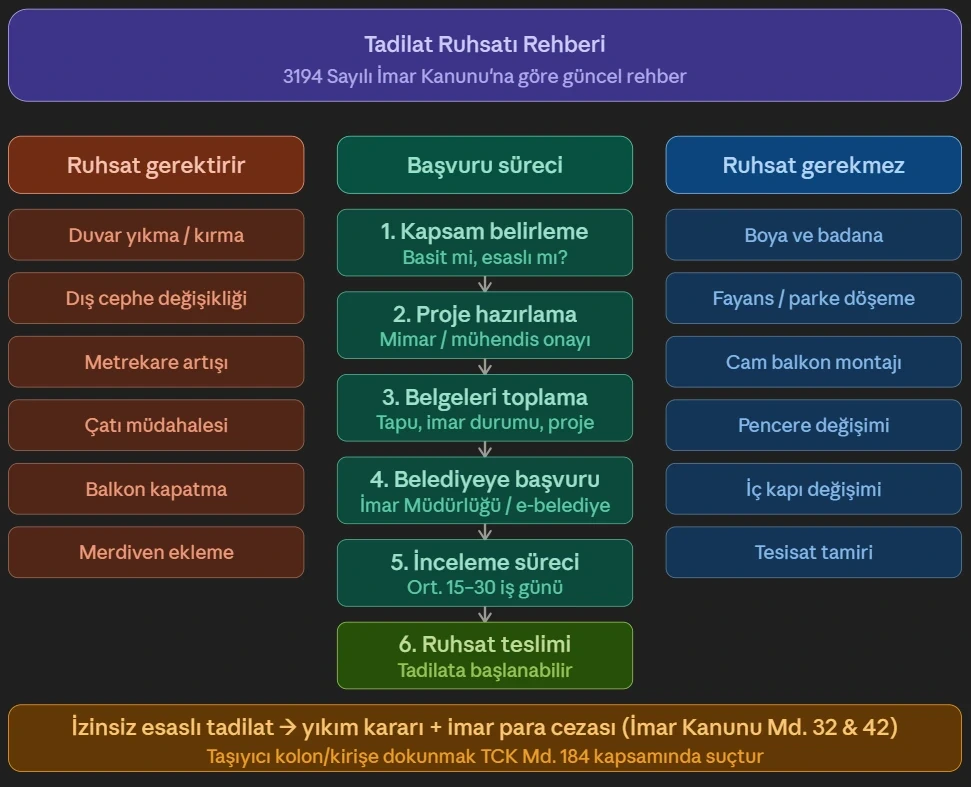
1. What Is a Renovation Permit?
A renovation permit is the official permit document obtained from the relevant municipality for "substantial changes" to an existing structure. In Turkey, all construction and building activities are regulated within the framework of Zoning Law No. 3194. According to this law, any work that affects the building's structural system, exterior appearance, or the square meterage of the independent unit is subject to a permit.
The main purposes of obtaining a renovation permit are as follows:
To preserve the building's structural safety
To ensure legal compliance and protect against possible penalties
To make future property sales easier
To safeguard condominium ownership and neighborhood rights
2. Which Renovation Works Require a Permit?
According to Article 4/y of the Planned Areas Zoning Regulation, the following changes fall within the scope of "substantial renovation" and a permit must be obtained:
Type of Renovation | Description |
Wall demolition / breaking | Load-bearing/partition wall demolitions carried out to combine or expand rooms |
Exterior facade changes | Changing window locations, opening new windows, enclosing a balcony into a room |
Increase in square meters | Any work that changes the gross or net area of the independent unit |
Roof interventions | Raising the roof, changing its shape |
Adding stairs | Adding interior stairs to duplex apartments |
Construction of additional space | Adding a new volume to the structure |
Balcony enclosure | Permanent glass balcony or conversion into a room |
Relocation of wet areas | Changing the location of the bathroom or kitchen |
Important rule: If the work you will do affects the building's silhouette, square meterage, or structural system, it is "substantial renovation" and submitting a project to the municipality is mandatory.
3. Renovation Works That Do Not Require a Permit
For the following works defined as "simple renovation", you do not need to obtain a permit from the municipality:
Painting and whitewashing – Painting interior walls
Tile laying – Renewing floor or wall coverings
Parquet flooring – Changing the floor covering
Electrical installation – Repairs that do not alter the existing system
Water and plumbing repair – Piping that does not touch the structural elements
Window replacement – Renewing windows in the same size and location
Interior door replacement – Renewing the door in the existing opening
Partition wall construction – Light (non-load-bearing) divider walls
Glass balcony application – Foldable retractable glass panel
Repair of railings, pergolas, gazebos
Repair of chimneys and eaves
Critical warning: Even though these works are allowed, the building's load-bearing columns, beams, and shear walls must absolutely not be touched. Thinning columns or shaving beams to enlarge the living room is both a crime under the Turkish Penal Code and an act that destroys earthquake safety.
4. How Do You Get a Home Renovation Permit? (Step by Step)
Step 1: Determine the Scope of the Renovation
Understand whether the work you will carry out is "simple renovation" or "substantial renovation." If you are unsure, consult the local municipality's zoning directorate or get the opinion of an architect/civil engineer.
Step 2: Have the Project Prepared
If substantial renovation is involved, have a licensed architect or civil engineer prepare the architectural and structural project.
Step 3: Gather the Required Documents
Prepare the title deed, zoning status document, project, and petition (details in the section below).
Step 4: Apply to the Municipality
Apply to the Zoning and Urban Planning Directorate of the municipality in your district. Many metropolitan municipalities now offer online applications through the e-municipality / e-permit system.
Step 5: Wait for the Review Process
The municipality reviews the application with the technical team. If there is a missing document, it notifies you within the first 15 days.
Step 6: Receive the Permit
If the application is complete, you will have the permit in hand in an average of 15–30 days.
Step 7: Notify the Municipality When the Renovation Is Completed
After the permit is obtained, the renovation must be completed within the specified period, and the municipality must be notified to prove that the renovation was carried out in compliance with the permit.
5. Documents Required for a Renovation Permit
Although it varies from municipality to municipality, the standard application documents are as follows:
Renovation permit application petition – It must include district, neighborhood, map sheet, block, and parcel information
Title deed registration document (copy of the title deed)
Zoning status / site plan document – Obtained from the municipality
Architectural project – Prepared by a licensed architect
Structural (reinforced concrete) project – Approved by a civil engineer
Electrical and installation projects (if required)
Reference sketch or dimensioned sketch (if none exists)
Copy of the apartment owners' resolution book – Especially if there is intervention in common areas
Before applying, we recommend confirming the current document list by checking your own municipality's website or calling the zoning directorate. Each municipality may have additional requirements.
6. Renovation Permit for Detached Houses
The process of obtaining a renovation permit for detached houses (single houses located on a separate parcel) is simpler in some respects than for apartment units:
No condominium owners' board decision is required – You do not need neighbor approval
However, a municipal permit is still mandatory – For works that fall under substantial renovation
For works affecting the building's exterior facade, roof, or structural system, architectural and structural projects are required
If a new additional area will be built on the parcel, attention must be paid to zoning plan conditions (TAKS, KAKS, setback distances)
7. Renovation Permit for Village Houses
Structures in village settled areas and within village boundaries may be subject to different regulations when they fall outside municipal adjacent area boundaries:
Structures within the village settled area:
Under Article 27 of the Zoning Law, simple construction and repair can be carried out with the permission of the village headman and council of elders
A permit certificate from the headman's office may be sufficient instead of a permit (depending on the size of the structure and the work to be done)
If the work is new construction or large-scale substantial renovation, a permit from the provincial special administration may be required
Vineyard house / structures on agricultural land:
In non-residential areas, construction without a permit may be possible with ministerial approval, provided that the ground floor area does not exceed 75 square meters and 2 floors
In any case, it is recommended to contact the provincial directorate of agriculture and the provincial special administration
For village houses, since the process goes through institutions different from the municipality (the headman's office, provincial special administration, Provincial Directorate of Environment and Urbanization), the best approach is to apply in person to the administrative unit to which your village is attached.
8. How Many Days Does a Renovation Permit Take?
Standard period: 15–30 business days
If there are no missing or incorrect documents in the application, the renovation permit is issued in an average of 15 days
According to some sources, this period may be extended to 30 days
If the municipality notifies missing documents within the first 15 days, the process restarts after the documents are completed
In metropolitan municipalities, applications made through the e-municipality system are said to be completed in an average of 7 business days
The validity period of the preliminary renovation permit (project approval) is 45 days; within this period, the renovation must be completed and reported to the municipality
9. How Much Does a Renovation Permit Cost?
Renovation permit fees vary depending on the municipality, the type of structure, the size of the project, and the scope of the work. There is no fixed tariff.
The general cost items are as follows:
Architectural project preparation fee – Free market; varies according to the architect and the size of the project
Municipal fees – Transaction fees collected under zoning legislation (varies by municipality)
Building inspection fees – Applicable in large-scale projects
For current and accurate information, we recommend checking the official website of the municipality you will apply to or calling its zoning directorate. Municipalities update their fee and charge schedules every year.
10. From Whom Do You Get Permission to Renovate a Home?
The renovation permit process involves more than one authority depending on the type of property:
1. Municipality (zoning directorate): Always required for substantial renovation. Application is made to the municipality of the district where the building is located.
2. Condominium owners' board: In common ownership such as apartment buildings or housing sites, for changes to the exterior facade, balcony, or common areas, the written consent of 4/5 (four-fifths) of all condominium owners must be obtained (Condominium Ownership Law No. 634, Article 19).
3. Tenant–landlord relationship: A tenant cannot make structural changes without the landlord's permission. Renovations that touch the structural system, change the area, or spoil the appearance require the landlord's written approval. If the tenant's intention to renovate was stated from the beginning, this should be included in the lease agreement.
4. KUDEB (Conservation Implementation and Supervision Bureau): For renovations in registered historic buildings and structures in protected areas, first apply to KUDEB. A "Repair Preliminary Permit Document" is obtained; it is reviewed and approved by at least 2 experts.
11. Can the Homeowner Make Renovations Without Permission?
The answer to this question depends on the type of property and the renovation to be done:
If you own a detached house: You can freely have simple renovations carried out that do not require a municipal permit. However, a municipal permit is still required for substantial renovation.
If you own an apartment unit:
You can freely carry out simple interior renovations that do not touch the structural elements
For any change affecting the exterior facade, balcony, or common areas, 4/5 condominium owner approval is mandatory
For noisy renovations that disturb neighbors, there are working-hour restrictions: work may be carried out on weekdays between 10:00–18:00, and noisy work is prohibited on Sundays and public holidays
12. How Much Is the Penalty for Unauthorized Renovation?
The legal consequences of carrying out substantial renovation that requires a permit without authorization are severe:
Fine
Under Article 42 of Zoning Law No. 3194, an administrative zoning fine is imposed
2024 minimum administrative fine: approximately 5,249 TL (updated every year according to the revaluation rate)
According to some sources, the minimum fine imposed by municipal council decision in 2024 is at the level of 8,542 TL
The fine may be increased depending on the size of the building, its location, and the nature of the violation
Prison Sentence
Carrying out construction without a building permit or causing a building to be constructed contrary to the permit предусматривает, under Article 184 of the Turkish Penal Code, a prison sentence of 1 to 5 years
Demolition Order
When the municipality detects an illegal structure or unauthorized substantial renovation, it may issue a stop-work order
If the renovation permit cannot be presented, the municipality has the authority to demolish the relevant section
13. What Happens If a Renovation Permit Is Not Obtained?
Carrying out substantial renovation without a permit puts your property at serious risk:
Legal consequences:
Your property falls into the status of an "illegal structure"
The municipality demands a renovation permit as a result of a complaint or inspection
If the permit cannot be presented, demolition and fines come into effect
A lawsuit can be filed against neighbors who carry out unauthorized renovations within 6 months
Practical consequences:
If you sell or transfer your property and there is no renovation permit, the transactions become more difficult
If it is damaged in an earthquake, your insurance compensation process may be negatively affected
You may experience problems with bank loans or mortgage transactions
14. Where Should Unauthorized Renovation Be Reported?
If you think that your neighbor or someone in your immediate surroundings is carrying out substantial renovation without a permit, you can follow these steps:
1. District Municipality Zoning Directorate The most direct way is to apply to the municipality's zoning directorate with a written petition. Your petition, supported by address, title deed information, and, if possible, photographs, will be reviewed.
2. E-Government / CİMER (Presidential Communication Center) If the municipality does not take the necessary action, you can submit a complaint to higher authorities through CİMER.
3. Provincial Directorate of Environment and Urbanization You can apply to the provincial directorate, especially in areas outside municipal boundaries or in cases of major violations.
4. Legal route If you think the unauthorized renovation has harmed you, you can seek support from a real estate lawyer.
Up to How Many Square Meters Is No Permit Required?
The square-meter limit is not a criterion in itself. What is decisive is whether the work to be done is "simple renovation" or "major renovation." Interior decoration work that does not affect the load-bearing system, does not alter the exterior facade, and does not increase the floor area does not require a permit regardless of square meters. In village house and vineyard house construction, special exemptions may apply under the 75 m² and 2-story limit.
Is Home Renovation Prohibited?
No, renovation is not prohibited. However, legal permission is mandatory for works that fall under major renovations. Simple renovation work can be carried out freely.
Can a tenant make renovations without permission?
No. The tenant may not make any structural changes or any changes affecting the appearance without the landlord's written permission.
Can renovations be done on the weekend?
Quiet, simple work can be carried out. However, noisy work using tools such as drills, breakers, and perforators is prohibited on Sundays and public holidays. Weekday working hours are generally 10:00–18:00 (may vary according to the management plan).
How Long Is the Renovation Permit Valid?
The validity period of the preliminary permit for the renovation project is 45 days. The renovation must be completed and reported to the municipality within this period.
Real Estate Management